
Pest Library · Iowa
Ants
Five common Iowa ant species — and why each one needs a different treatment.
- Size
- Workers 1/16" – 5/8"
- Color
- Black, brown, red, or yellow depending on species
What it looks like
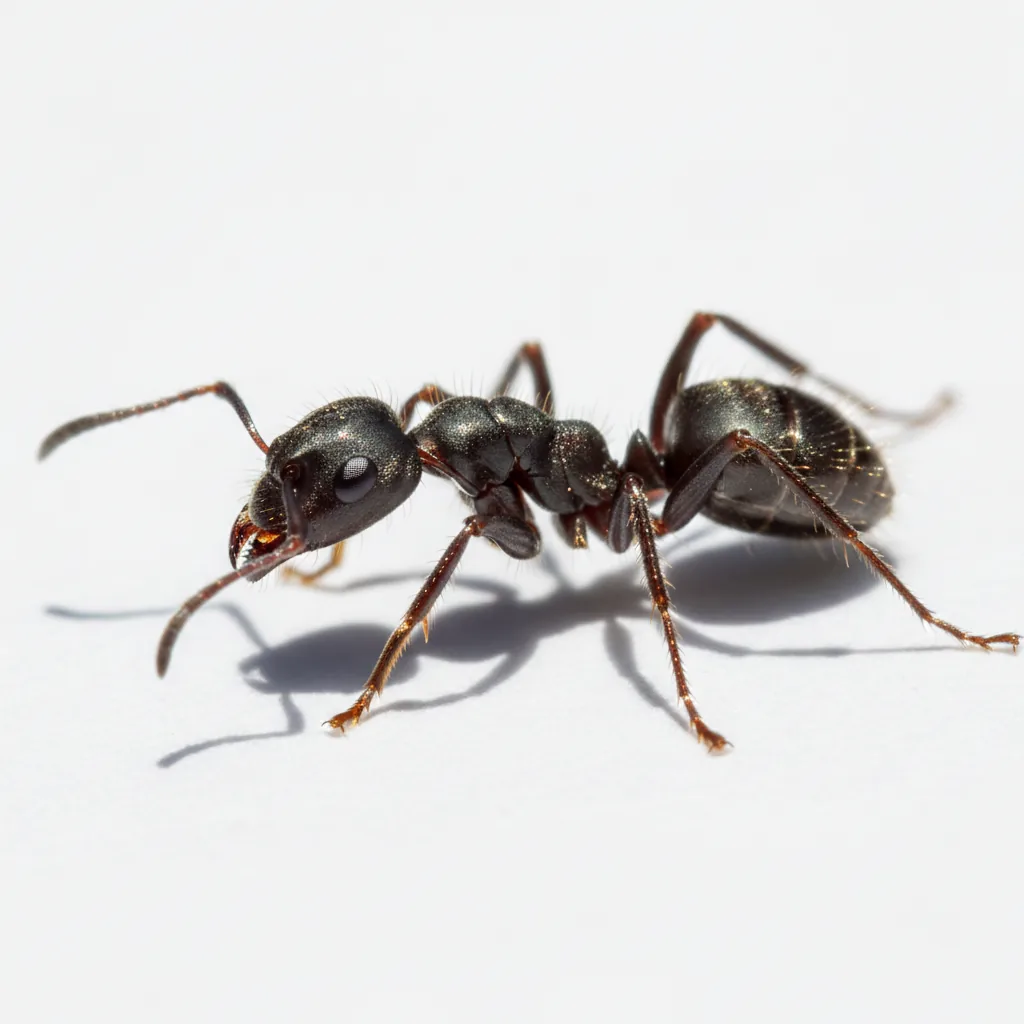
- Pinched 'waist' between thorax and abdomen (separates ants from termite swarmers)
- Bent or 'elbowed' antennae
- Three distinct body segments: head, thorax, abdomen
- Workers vary in size from 1/16" to over 1/2" depending on species
Where you'll find it
- Trails along baseboards, countertops, window sills, and patios
- Wall voids near plumbing, dishwashers, and exterior doors
- Mulch beds, landscape timbers, woodpiles, and tree stumps next to the foundation
- Damp wood: window frames, sill plates, leaky bathrooms (carpenter ants)
Behavior & biology
Ants are eusocial insects. A colony has one or more queens, sterile female workers, and seasonal winged 'swarmers' (alates) that fly out to start new colonies. Most Iowa ant problems are scout workers from a colony located within ~30 feet of the visible trail. Killing the workers you see does almost nothing — the queen will replace them in days. Effective control means getting bait or non-repellent insecticide back to the queen.
Iowa activity calendar
Peak Iowa activity months
Iowa ant pressure starts in April with pavement and field ant activity, peaks June–August, and surges again in September–October as colonies prep to overwinter inside walls. Carpenter ant swarms hit in late March and April.
Signs of an infestation
- Visible trails of workers along baseboards, counters, or window sills
- Sawdust-like 'frass' near wood trim or windows (carpenter ants)
- Faint coconut or rotten smell when crushed (odorous house ants)
- Tiny dirt piles in driveway cracks or sidewalk seams (pavement ants)
- Winged swarmers indoors in spring
Health & property risk
Most Iowa ants don't sting or carry disease — but carpenter ants chew structural wood (causing damage similar to, though slower than, termites), pharaoh ants can mechanically spread bacteria across food contact surfaces, and large indoor populations contaminate pantries and pet food.
How we treat it
- 1
Identify the species
We confirm whether you have carpenter, pavement, odorous house, pharaoh, or field ants. Treatment varies dramatically — and the wrong product can cause a colony to 'bud' into multiple new colonies.
- 2
Non-repellent perimeter + targeted baits
We apply non-repellent insecticide along trails and entry points so workers carry it back to the queen. For pharaoh and odorous house ants we use slow-acting protein/sugar baits placed where workers actually feed.
- 3
Seal entry points
We identify and seal cracks, plumbing penetrations, and weep holes acting as ant highways.
- 4
Follow-up
Most ant infestations clear in 7–14 days. Re-treatment is free if activity continues.
Why DIY usually fails
Big-box ant sprays kill the workers you see and leave the queen alone. Worse, repellent sprays cause many species (especially odorous house and pharaoh ants) to 'bud' — splitting into multiple smaller colonies that are harder to find and kill.
FAQ
See ants in your Iowa home?
Free quote, same-day service, no contracts.