
Pest Library · Iowa
Pavement Ant
Tetramorium immigrans
The small dark ant nesting under your driveway, sidewalk, and slab.
- Size
- 1/8" (about 2.5–3 mm)
- Color
- Dark brown to blackish, paler legs
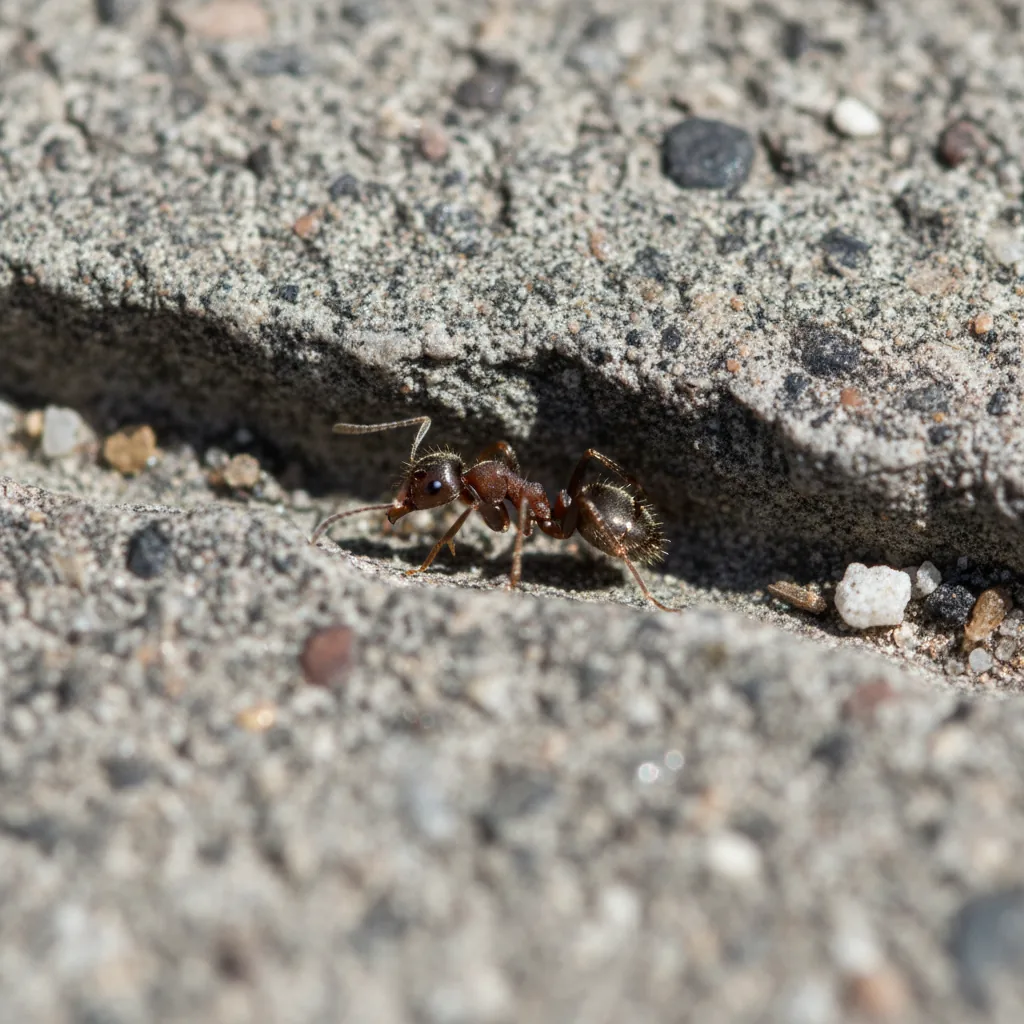
What it looks like
- Small, uniformly dark, ~1/8" long
- Two nodes between thorax and abdomen (a key ID point vs. carpenter ants)
- Faint parallel grooves on the head and thorax
- Workers all the same size (unlike carpenter ants)
Where you'll find it
- Under driveways, sidewalks, patios, and slab foundations
- Beneath landscape rocks, brick edging, and stepping stones
- Wall voids and under tile or laminate flooring
- Kitchen counters and pet food bowls (foraging trails)
Behavior & biology
Pavement ants nest in soil under flat hard surfaces, where the slab traps heat. Colonies have 3,000–10,000 workers and a single queen. They eat almost anything — grease, sugar, dead insects, pet food, seeds. Two neighboring colonies will fight 'pavement ant wars' on driveways in spring, leaving piles of dead workers.
Iowa activity calendar
Peak Iowa activity months
Activity starts in April when slabs warm up. Indoor foraging peaks May–August as the colony grows. September–October sees a second push as workers stockpile food before winter.
Signs of an infestation
- Small piles of fine soil in cracks of driveways, sidewalks, and patios
- Long trails of small dark ants on counters, stoves, and floors
- Activity concentrated near slab edges, expansion joints, and garage thresholds
- Dead ants in clusters in spring (territorial wars)
Health & property risk
Pavement ants don't bite, sting, or damage wood. The risk is contamination — they walk on garbage, pet waste, and dead insects, then onto food prep surfaces.
How we treat it
- 1
Bait the trails
We use slow-acting sweet and protein baits placed on active trails so workers carry it back to the queen.
- 2
Treat slab edges + cracks
We apply non-repellent insecticide along expansion joints, slab edges, and the garage threshold — the actual nest entrances.
- 3
Exterior perimeter band
A 3-foot perimeter band around the foundation prevents new colonies from establishing.
Why DIY usually fails
Dust-style ant killers and cinnamon won't reach the queen. Liquid baits work but only if you don't also spray repellent — the two products fight each other.
FAQ
Related pests
Ready to get rid of pavement ant?
See our service & pricing page for pavement ant.
See Pavement Ant Service →See pavement ant in your Iowa home?
Free quote, same-day service, no contracts.